Is the lowest hourly rate usually the best quote?
No. Minimum hours, garage travel, mileage and added charges can reverse the comparison. Calculate the complete written total for the same itinerary before you decide.
Compare party bus quotes only after every company prices the same date, the same vehicle requirement, the same route and the same service window. Use the complete written total—not the headline hourly rate—and check minimums, garage time, mileage, gratuity, tax, parking, overtime, cancellation and substitution language.
Free Quote
Reviewed by our booking team · Written contract before your date is held
Decision framework
| Factor | What to check | Why it matters |
|---|---|---|
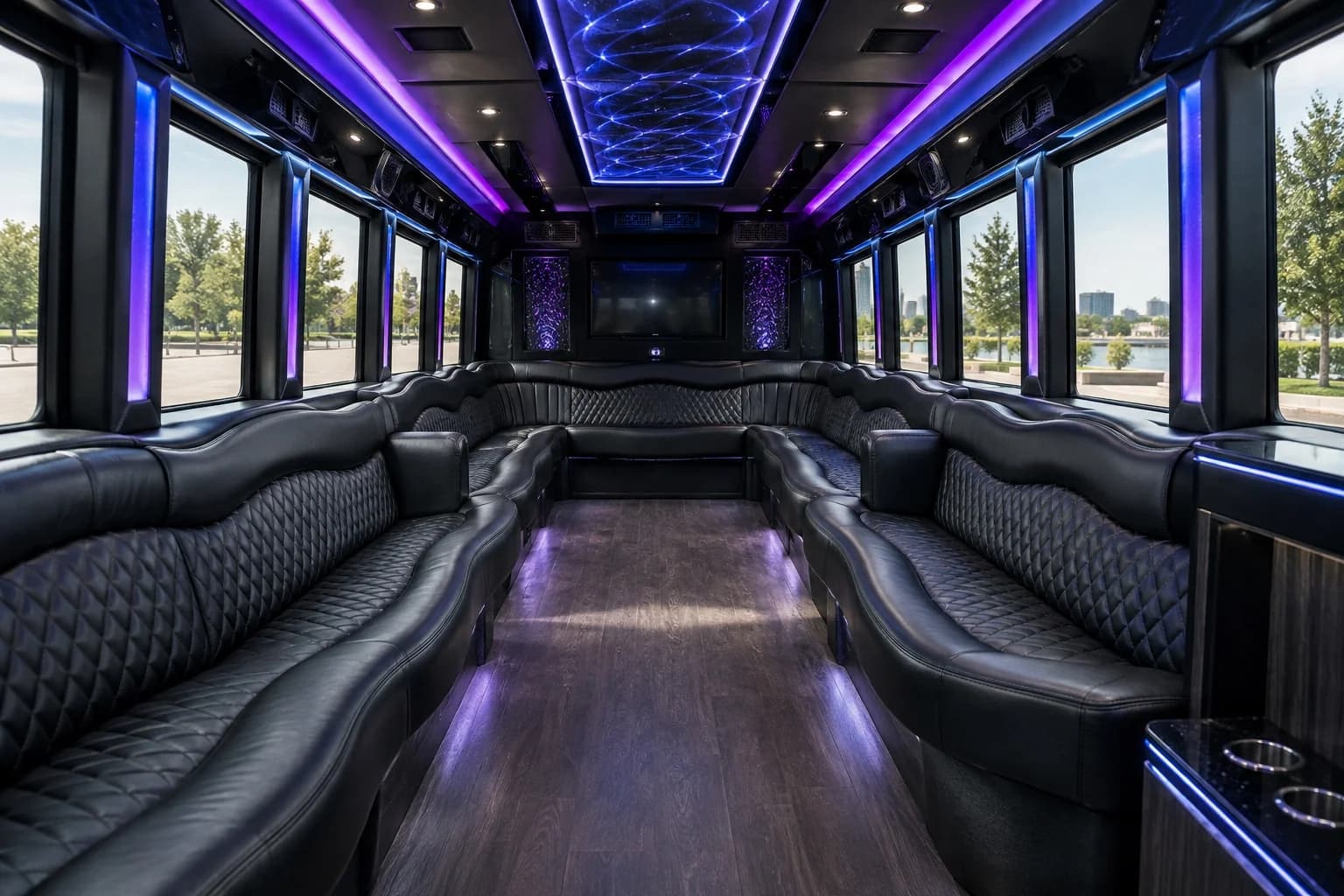
| Vehicle | The exact bus, its seated capacity and current photos | Category labels alone do not make two offers equivalent. |
| Billable time | Clock start, clock end, minimum and rounding | Two five-hour itineraries may produce different billable totals. |
| Charges | Every included, excluded and variable amount | A low base rate can become the higher final total. |
| Risk terms | Cancellation, substitution, breakdown and overtime | The contract defines the value if plans change. |
A useful comparison keeps the service scope constant. If the vehicle, route, time or included charges change between offers, document the difference before treating one total as better. The written agreement—not an advertisement, calculator or verbal summary—controls the actual transaction.
Two companies can quote the same bus for the same Saturday at $150 and $190 an hour and the $190 offer can be the cheaper trip. The rate only becomes a price once you know what it multiplies: the minimum block, whether the clock starts at the garage or at your door, how overtime is rounded, and which of the fuel, gratuity, tolls, parking and cleaning charges sit outside the rate. A five-hour evening on a four-hour minimum with garage-to-garage billing and a 20% service charge can cost more than a six-hour quote that already has all of it inside one total.
So the first thing to do with any quote is to turn it into a single number for your actual itinerary: pickup time, every stop, the return, and the hours that implies. If a quote cannot be turned into that number without a phone call, it is not yet a quote. Ours prints that number, with the overtime rate alongside it, so the comparison is one line against one line.
Most bad comparisons start with the request, not the reply. One company hears "about twelve people, downtown, around seven", another gets a written itinerary with addresses and times, and the two quotes describe different jobs. Send every company the same page: the date, the confirmed headcount plus two, the first pickup address and time, every stop in order with roughly how long you intend to spend there, the final drop-off, and anything that changes the vehicle, such as coolers, a wheelchair, instruments or luggage.
Then insist on the same specificity coming back. The vehicle should be named, not described as "a 20 to 24 passenger party bus". Its seated capacity should be a number. The photos should be of that bus, dated. If a company substitutes freely, ask what the substitution rule is in writing, because a 30-passenger coach swapped in for a 24-passenger lounge bus is a different evening.
The total is what you pay if everything goes to plan. The terms are what you pay when it does not, and plans change more often than people expect: a headcount drops, a venue moves, weather shortens the night. Look for the cancellation deadline and what fraction of the deposit you lose at each stage, whether rescheduling is free inside a window, what happens if the vehicle breaks down an hour in, and whether overtime is billed in full hours or fifteen-minute increments.
A quote that is a few dollars cheaper per hour but carries a non-refundable deposit and full-hour overtime rounding is a worse bet for an evening with any uncertainty in it. We would rather you compared our terms line by line against anyone else’s than picked us on the rate alone, which is why they are printed on the quote rather than linked from it.
Working checklist
Use one written itinerary for every company
Ask for the legal business name on the contract
Require an itemized total
Confirm the exact vehicle in writing
Record every variable charge
Keep all revisions in writing
Direct answers
No. Minimum hours, garage travel, mileage and added charges can reverse the comparison. Calculate the complete written total for the same itinerary before you decide.
Treat the offer as incomplete. Ask for the exact bus or a clear substitution standard, its seated capacity and current photos before you pay anything. We name your vehicle from our fleet in writing.
Important terms should appear in the written quote or contract. Save approved changes and payment receipts.
Review vehicle assignment, charges, timing, cancellation and service-recovery terms before paying a deposit.
Check the company identity, the operating authority that applies and the public safety record before you book group transportation.
Plan passenger capacity, luggage, mobility devices and usable space before choosing a transportation vehicle.
From our own bookings
Across our bookings
Short notice is normal here: 26% of the trips we run come in inside the last 14 days. The later the call, the shorter the list of vehicles still free.
Across our bookings
17% of sports-event bookings come in inside a week of the date, and 18% land ninety days or more ahead.
Across our bookings
12% of our bookings are weddings.