Should I book to the listed maximum capacity?
Not automatically. Luggage, clothing, mobility needs and the actual layout may make a lower passenger count more practical.
Choose a vehicle using the exact passenger count plus luggage, mobility and boarding needs. Legal seating capacity does not measure usable luggage space or comfort. Ask us to confirm your vehicle’s seating layout, storage compartments, aisle access and any accommodations you need, all in writing.
Free Quote
Reviewed by our booking team · Written contract before your date is held
Decision framework
| Factor | What to check | Why it matters |
|---|---|---|
| Passengers | Final manifest and legal seating capacity | Every passenger needs an approved seat. |
| Luggage | Bag count, size and storage location | Cabin space should not be assumed to hold luggage safely. |
| Mobility | Lift, securement, steps and aisle needs | Accessibility depends on the exact vehicle and service. |
| Layout | Current diagram or vehicle media | Vehicles in one category can have different interiors. |
A useful comparison keeps the service scope constant. If the vehicle, route, time or included charges change between offers, document the difference before treating one total as better. The written agreement—not an advertisement, calculator or verbal summary—controls the actual transaction.
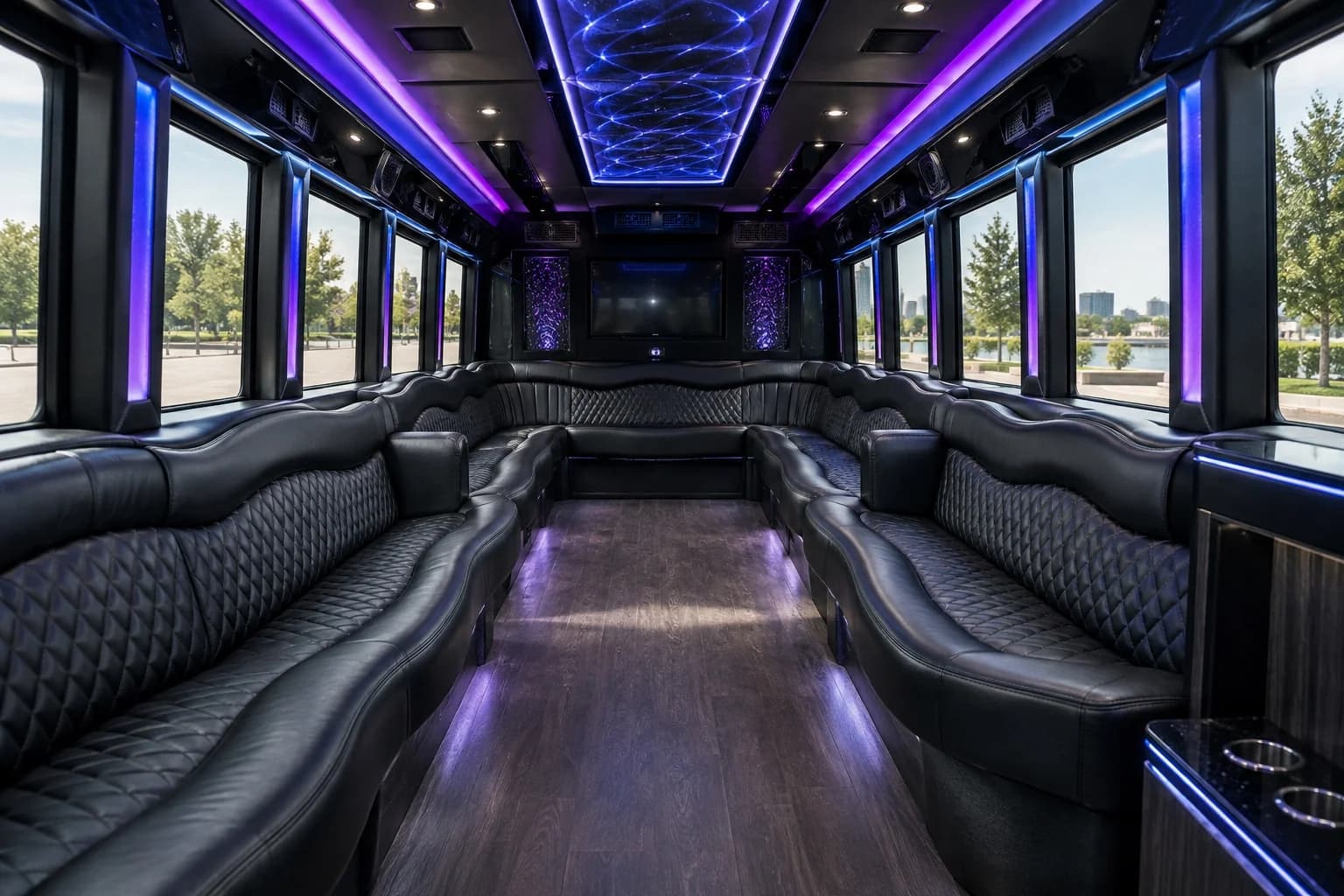
Every vehicle has a legal seated capacity, set by the number of seating positions and the vehicle’s certification. That number assumes average adults in ordinary clothes with nothing on their laps. Comfortable capacity is lower: a 20-passenger party bus with perimeter seating holds twenty people who are willing to sit shoulder to shoulder for the whole trip, and sixteen who are not. Add formal wear, winter coats, or a group that intends to stand and move around, and the gap widens.
Book from your confirmed headcount, add two for the inevitable extra guest, and compare that number to the comfortable capacity rather than the legal one. If the two figures straddle a vehicle size, the next size up is almost always cheaper than the regret, and we will tell you when the price difference between the two is small enough that the choice is obvious.
Party buses and limousines are built for people, not luggage. Most have no under-floor bays, and a cabin designed as a lounge has nowhere to stack suitcases safely; a bag in the aisle is a tripping hazard and in some states a violation. Sprinters vary: an executive Sprinter usually has a rear cargo area behind the last row, while a limo Sprinter often gives that space up for the bar and seating. Coaches and larger shuttles are the vehicles with real luggage bays, and for an airport run, a ski weekend or any trip with a bag per person, the bay is the reason to choose them.
Tell us the bag count and sizes at the same time as the headcount. We will tell you which of our vehicles has the space, or whether a second vehicle for luggage makes more sense than squeezing a coach into a trip that only needed a Sprinter.
A wheelchair, a walker, a stroller or an instrument case takes space from the passenger count, not from a luggage allowance that does not exist. A folded wheelchair can ride in a coach bay; an occupied one needs a lift-equipped vehicle with a securement position, which removes two to four seats from the count. Child seats need a forward-facing seat with a lap and shoulder belt, which rules out most perimeter-seated party buses entirely.
The practical rule: list every item that will board that is not a person, and let us size the vehicle around the list. We would rather send a 14-passenger vehicle that fits everyone and everything than a 12-passenger one that is legal on paper and miserable in practice.
Working checklist
Count passengers by pickup wave
List checked and carry-on bags
Document mobility equipment
Ask where bags will be stored
Confirm legal capacity in writing
Leave room for uncertain attendance
Direct answers
Not automatically. Luggage, clothing, mobility needs and the actual layout may make a lower passenger count more practical.
Do not assume they do. Ask us about the storage on your exact bus and we will tell you where the bags will go.
Ask the carrier about safe storage and applicable rules. Plan dedicated storage rather than relying on aisle space.
Normalize routes, vehicles, billable time, fees and contract terms before comparing party bus quote totals.
Review vehicle assignment, charges, timing, cancellation and service-recovery terms before paying a deposit.
Check the company identity, the operating authority that applies and the public safety record before you book group transportation.
From our own bookings
Across our bookings
Wine tours are 2% of our bookings.
Across our bookings
October accounts for 10% of the trips we book.
Across our bookings
Our busiest months are May, August, September and October; January and February are the quietest. Spring proms and graduations and early-autumn weddings and football are when popular vehicles are hardest to get on short notice.