Can one driver operate an unlimited itinerary?
No. Applicable hours-of-service rules and the carrier’s operating plan constrain driving and on-duty time.
Long-distance and overnight transportation requires more than multiplying miles by a rate. Provide the full schedule, passenger and luggage count, planned stops and overnight locations. Ask the carrier to explain driver-hours compliance, relief-driver or lodging needs, mileage, tolls, parking and service-recovery arrangements.
Free Quote
Reviewed by our booking team · Written contract before your date is held
Decision framework
| Factor | What to check | Why it matters |
|---|---|---|
| Schedule | Complete door-to-door operating timeline | Driving and on-duty time affect feasibility. |
| Driver plan | Relief chauffeur, rest or lodging requirements | We build and own the compliant operating plan for your trip. |
| Vehicle | Luggage, restroom and accessibility needs | Long trips magnify layout problems. |
| Recovery | Breakdown and delay response | Distance can limit replacement options. |
A useful comparison keeps the service scope constant. If the vehicle, route, time or included charges change between offers, document the difference before treating one total as better. The written agreement—not an advertisement, calculator or verbal summary—controls the actual transaction.
Under federal hours-of-service rules a passenger-carrying driver may drive up to ten hours after eight consecutive hours off duty and may not drive after fifteen hours on duty. Those limits, not the distance, decide whether one chauffeur can run your trip. A departure at six in the morning for a four-hour drive, a day at the destination and a return that evening is well past fifteen hours on duty even though the driving is only eight. The honest options are a second chauffeur, an overnight for the driver, or a different schedule.
We plan the staffing when we quote, so the sheet shows whether the trip runs with one chauffeur, a relief chauffeur or a driver overnight, and what each costs. Any company that quotes a sixteen-hour day with one driver and no comment either has not read your itinerary or is planning to break the rule.
Mileage, which on long trips matters more than hours, and whether it is billed from the garage or from your pickup. Tolls on the actual route. Fuel, if it sits outside the rate. Driver lodging and meals for an overnight, and who books the room. Parking at the destination, which at a stadium, a resort or a city center can be a surprising line. And the deadhead: if the vehicle drops the group on Friday and returns empty to collect them on Sunday, that is two extra one-way runs, and they should be on the sheet whether or not they are charged.
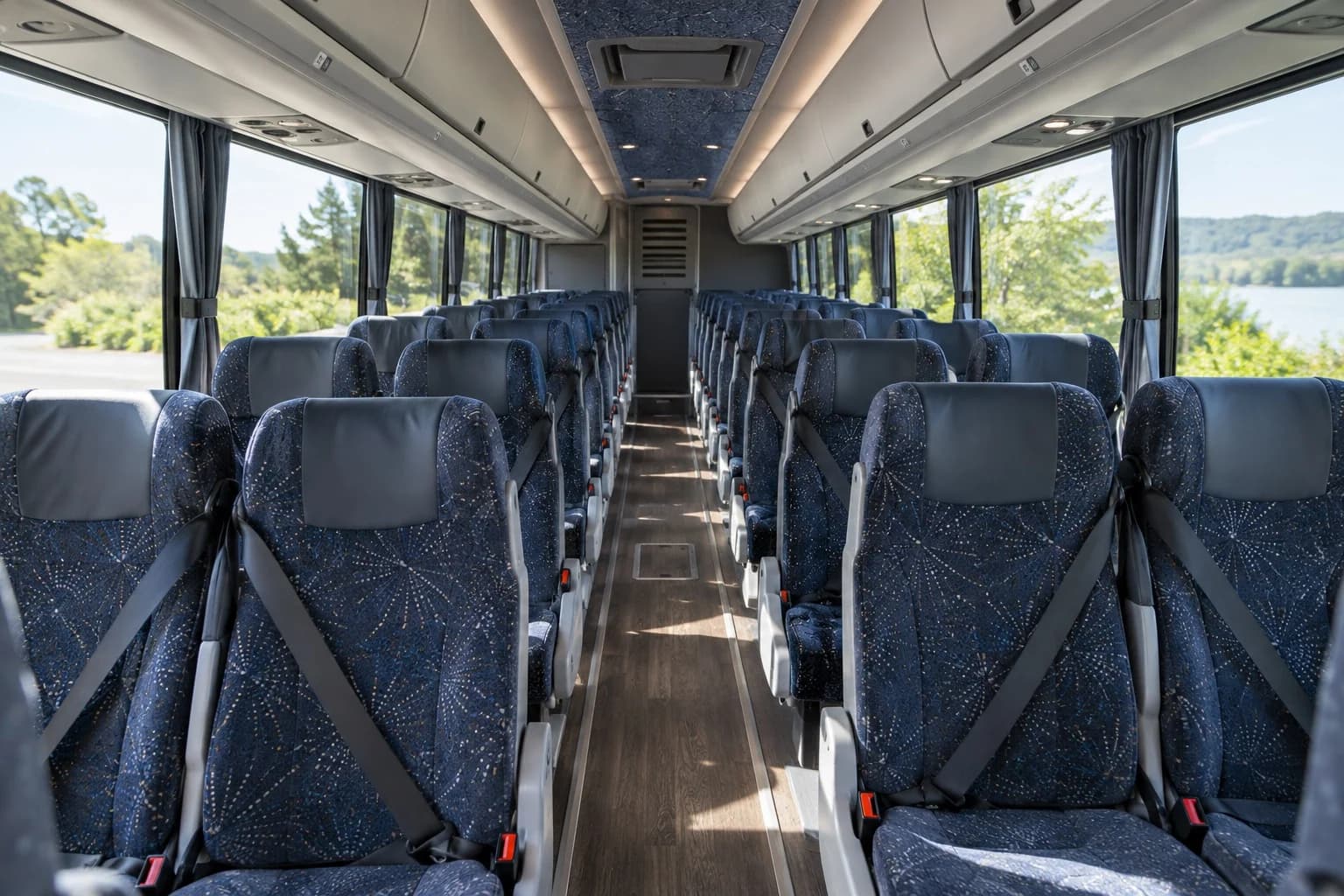
Then the vehicle itself. A long trip is where a restroom, reclining seats, luggage bays, power outlets and a working climate system stop being amenities and become the trip. For anything over three hours, a coach is the honest recommendation over a party bus, however the day ends.
A breakdown twenty minutes from base is a replacement vehicle inside the hour. A breakdown four hundred miles out is a different problem, and the contract should say what the company will actually do: the nearest affiliated operator, the time to recovery, who pays for accommodation if the group is stranded overnight, and how the unused hours are credited. Ask for this in writing; "we have never had a breakdown" is not a plan.
Keep a group manifest with phone numbers and emergency contacts on the vehicle and with the organizer, and give the organizer our dispatch number. Long trips go wrong slowly, with a weather front or a closed interstate, and the groups that handle it well are the ones who can reach a dispatcher who can re-route and re-book before the vehicle reaches the problem.
Working checklist
Provide every travel day
List planned rest stops
Confirm luggage storage
Ask for the driver-hours plan
Itemize lodging and parking
Keep emergency contacts and manifests
Direct answers
No. Applicable hours-of-service rules and the carrier’s operating plan constrain driving and on-duty time.
The written quote should state whether lodging is included, customer-provided or charged separately.
Ask for the actual service-recovery terms. Do not assume an immediate replacement is guaranteed.
Normalize routes, vehicles, billable time, fees and contract terms before comparing party bus quote totals.
Review vehicle assignment, charges, timing, cancellation and service-recovery terms before paying a deposit.
Check the company identity, the operating authority that applies and the public safety record before you book group transportation.
From our own bookings
Across our bookings
7% of our booked trips go out on a limousine.
Across our bookings
Friday is the date on 20.1% of our bookings.
Across our bookings
31.6% of the trips we book come in 31–90 days ahead of the date.